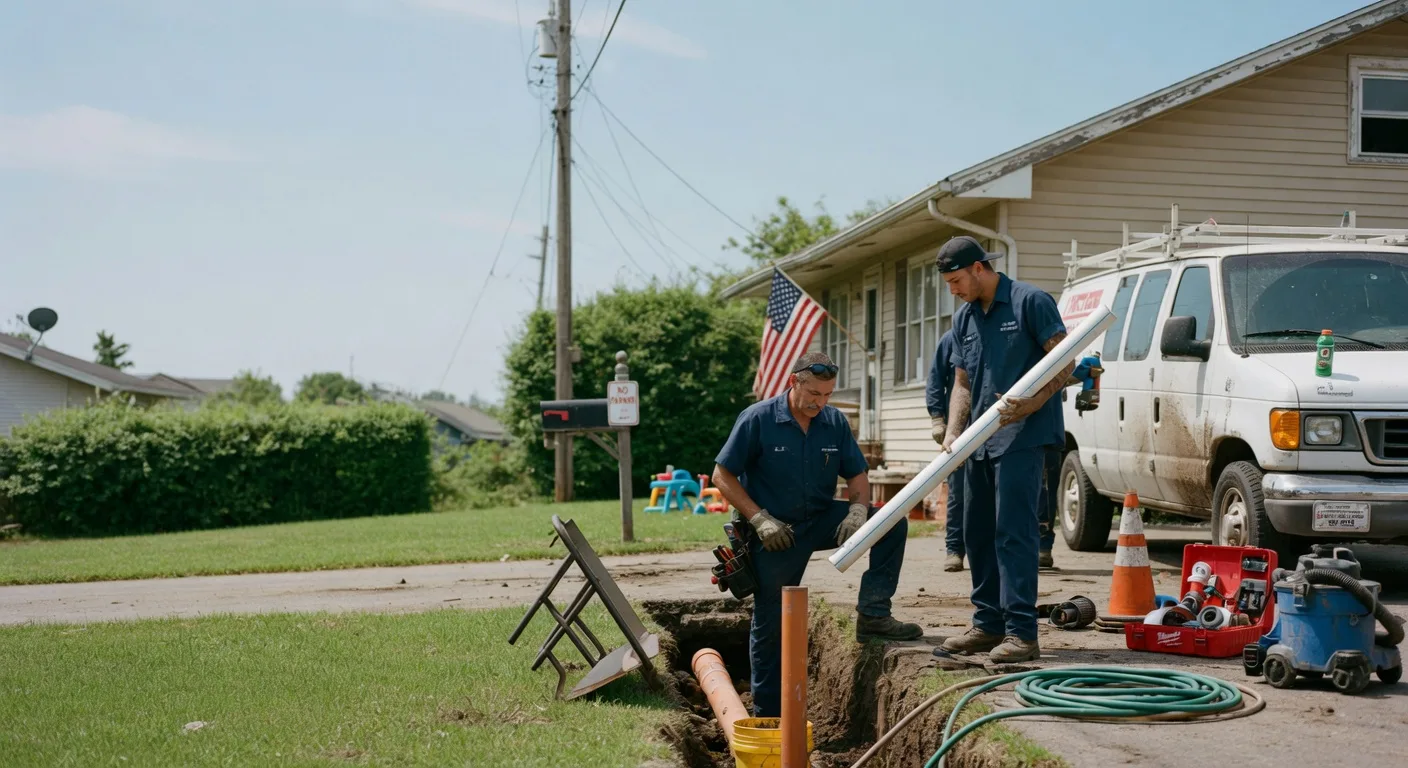
How much does it cost to fix a blocked drain?
Expert Plumbers Co does not set or quote prices. It connects you with an independent local plumber, and that plumber names the number after seeing the actual problem. Several things drive the cost of a blocked drain. The first is where the clog sits. One slow sink with hair a few feet past the trap is a short cable job, while every drain in the house backing up points to the main line, which needs larger equipment and more time. The second is access. A clear, reachable cleanout keeps the work simple; if the plumber has to pull a toilet to reach the line, that adds labor. The third is the method. A cable machine punches a channel through a clog, hydro jetting scours the full pipe wall, and a camera inspection shows the pipe's condition so the plumber can tell whether cleaning is enough. The fourth is the pipe itself. Roots in clay joints, scale inside cast iron, or a bellied section holding water can turn a cleaning into a repair, and repairs bring in digging or lining, materials, and sometimes a permit. A plumber in The Sea Ranch, CA can narrow this down quickly once you say which fixtures are affected and how long it has been going on.
Before the plumber arrives, write down a few facts that shape the scope of work. Note which fixtures are affected, when the problem started, and whether anything unusual went down the drain beforehand, such as wipes, a large amount of grease, or a child's toy. Find the cleanout, which is usually a capped pipe in the basement, the crawlspace, or outside near the foundation, and clear a path to it. Tell the plumber about any past backups or earlier repairs on that line. Ask them to explain the method before starting, and to say what the next step would be if the first approach does not clear the line. If a camera is used, ask to see the footage so you understand what is wrong. Any work beyond cleaning should be described to you before it begins, including how much has to be opened up and whether a permit applies.
What does a camera inspection show and is it worth it?
A camera inspection feeds a waterproof lens on a flexible cable through the line, usually from a cleanout, and shows what is happening inside the pipe on a screen. It shows a cracked or offset joint, roots growing in through a seam, a bellied section holding standing water, grease coating the wall, or scale narrowing a cast iron pipe. Each of those looks different on camera, and each calls for a different fix. Clay pipe tends to show root intrusion at the joints. Cast iron shows a rough, flaking interior that narrows year by year. PVC usually shows a smooth wall, so a clog there is more likely debris or a low spot. The value is that a cable or jet only clears the blockage, while a camera shows what caused it. It is worth doing any time a drain clogs repeatedly in the same place, when several fixtures back up together, or before any repair or lining work is planned, so the plumber fixes the right section. A camera paired with a locator can also mark how deep the pipe runs. A plumber in The Sea Ranch, CA can run one and explain what it shows, and Expert Plumbers Co can connect you with one.
What you do with the footage matters as much as the inspection itself. Ask the plumber to show you the screen while the camera is in the line, or to save the video, and to point out the distance from the cleanout where each problem sits. That distance lets you compare the findings with what you know about the house, such as the location of a tree, a driveway, or an addition. If you are buying or selling a home, a recording of the sewer line gives both sides something concrete to look at. Keep the video, since a later plumber can compare it with the line's current state. A camera cannot see through standing water, so a bellied section may show only as a pool rather than a clear view. Tell the plumber if the line has been jetted recently, as a clean pipe gives a clearer picture.
What is the difference between a septic system and a city sewer line for drain problems?
The two systems fail in different places, so the first job is knowing which one your home has. A city sewer line carries wastewater from your house to a municipal main, so trouble is usually confined to the pipe: roots at a clay joint, a bellied section, scale in old cast iron, or a blockage in the lateral. Every drain in the house backing up at once typically means the private line or the connection at the street. A septic system adds a buried tank and a drain field. Solids settle in the tank, and liquid flows out through perforated pipe into the soil. Slow drains or backups can mean a tank that is full and overdue for pumping, a clogged outlet filter or baffle, a failing drain field that can no longer absorb water, or a blockage in the short line between the house and the tank. Soggy ground or a strong odor over the tank area points away from the house plumbing. A cable machine or hydro jetting can clear the house line on either system, but jetting into a septic line needs care about where the water and debris end up. Property paperwork, a cleanout location, or the water utility can tell you which system you have. Expert Plumbers Co connects homeowners with an independent local plumber who works on that type of system.
Homeowners often assume a septic problem and a city sewer problem look the same from the bathroom, but there are a few quick clues. On city sewer, a backup after heavy use is usually the private line or the lateral at the street, and neighbors on the same main may have had the same trouble. On septic, the problem tends to build slowly: drains slow down across the house, the toilet flushes weakly, and a patch of lawn stays wet or unusually green. A common mistake is pouring additives into a septic tank hoping to fix a failing drain field. They do not repair soil that has stopped absorbing water. When you call, tell the plumber how old the system is, when the tank was last opened, and where the cleanout or lid sits. In older homes the tank may be buried deeper than expected and need to be located first, which adds time before any repair starts.
The toilet flushes slowly but never fully clogs. What is going on?
The toilet flushes, the bowl drops slowly, and it creeps back up before settling. It never fully clogs, so it is easy to ignore. Do not ignore it.
A slow flush means something is partly in the way. There are three common causes. First, the trap or the pipe just past it is narrowed by paper, wipes, or grease and soap scale on the pipe wall. Second, the vent stack on the roof is partly blocked, so air cannot follow the water down. You may hear gurgling or see the bowl bubble. Third, the branch line is bellied, or has roots at a joint, and water moves through it slowly.
Check one thing first: is it only this toilet, or are the tub, sink and other toilets slow too? One slow fixture points to that fixture's branch. Slow everywhere points to the main line or lateral, which is a different job with different equipment.
Safe homeowner check: use a plunger, stop flushing wipes, and watch whether it comes back. Stop running water and call now if other drains gurgle when you flush, water rises in a tub, or there is a sewage smell in the house.
A cable machine usually clears a single branch. Recurring slowness, roots or grease often call for hydro jetting, and a camera inspection shows which. Expert Plumbers Co is a referral service. Call (380) 262-9173 to be connected with a plumber in The Sea Ranch, CA for Drain Cleaning.
A slow flush that gets worse over a few weeks is a sign that the cause is growing, not stable. If the water is also making a gulp or a bubble in a nearby sink or tub when you flush, that points toward air being pulled through a trap, which is the vent stack problem. Check whether the slowness is worse during heavy rain or after the washing machine runs, because that tells the plumber whether the main line is filling up. Do not keep adding more water in the hope that the extra weight will push the blockage through, since it can drive waste up into the lowest opening. Tell the plumber if the toilet was recently moved, replaced or fitted with a water-saving model, because a low-flow toilet on an old line with little fall can leave solids behind. In older homes, the toilet branch is often a long run with a modest slope, which makes it more likely to hold debris.
The street sewer backed up into my house. What is a backwater valve?
Sewage came up through the basement floor drain, or a low toilet or tub gurgled and overflowed, during a storm or a heavy-use evening.
The usual cause is the municipal main in the street filling past capacity, called surcharging. With nowhere to go, the flow pushes back up the lateral and out of the lowest opening in the house.
A backwater valve, also called a check valve, is a fitting on the lateral or building drain with a flap that lets waste leave and shuts when flow reverses. It sits on the line ahead of the branches serving the lowest fixtures.
Fitting one is not a quick swap. It usually means opening the floor or digging to reach the pipe. What it involves depends on access, the depth of the line, the valve and materials, how much has to be opened up and restored, and whether a permit or code sign-off is required. Rules vary by area.
A valve does not fix roots at a clay joint or a bellied line holding water. It only stops reverse flow. A private line problem needs a camera inspection first, then a cable machine or hydro jetting depending on what the camera shows.
Street or private? Ask three things. Are the neighbors affected? Did it coincide with heavy rain? Is only the lowest opening backing up while upper fixtures drain normally? Yes to those points to the street main. Only your house, in dry weather, points to your own lateral.
Safe homeowner check: look at the neighbors and the forecast. Stop running water now: no flushing, washer or dishwasher. Keep people and pets out of contaminated water, and call.
Expert Plumbers Co is a referral service. We connect you with an independent local plumber in The Sea Ranch, CA. Call (380) 262-9173.
After the cleanup, ask how the valve will be kept working. The flap and its hinge can be stopped by lint, grease and grit, and then it no longer seats fully. Most valves have an access cover so the flap can be looked at and cleaned, and that should be done on a routine, not only after a storm. Learn where the cover is and keep boxes and floor coverings off it.
One point catches people out. With the valve closed during a storm, your own household water has nowhere to go either. Showers, sinks and the washer will fill the line behind the flap, so keep water use low until the street main drops.
After any backup, the floor drain and the area around it need to be cleaned and disinfected. Porous materials that soaked up sewage, such as carpet pad and cardboard, usually have to be removed rather than dried.